Sales and Marketing, University 1st and 2nd Year (Level 4 and 5) - Onlinebusinessschool
Contact us

    Interested in our FREE laptop offer? Click here to find out more!

    Sales and Marketing

    £1900 per level or £2400 for two levels together

    Progress onto University final Year

    Choose your course option

    Extended Diploma in Management (Level 5)

    £1900

    Package Includes

    • University 2nd Year (Level 5) Full Course Materials and Assignments

    Also includes

    • Unlimited tutor support
    • Recognised Ofqual Qualification
    Enrol now
    Sales and Marketing (Level 4)

    £1900

    Package Includes

    • University 1st Year (Level 4) Full Course Materials and Assignments

    Also includes

    • Unlimited tutor support
    • Recognised Ofqual Qualification
    Enrol now

    About the course

    The Undergraduate Level 4 (Sales and Marketing) and Level 5 (Extended Diploma in Management) are a 240 credit course designed to fast track students to the final year of an associated Undergraduate degree in Sales and Marketing, which can either be completed at a UK university on campus or via distance learning.

    The Level 4 modules and assignments of this course are equivalent to the first year of a University Degree, and the Level 5 modules and assignments are equivalent to the second year of a University Degree.

    This course is made up of 10 Level 4 modules (120 credits) and 10 level 5 modules (120 credits), each level also includes 10 written assignments. If a student decides to only study at Level 4 they will receive 120 credits and can apply for an exemption from the first year of a university Degree course.

    Each module consists of approximately 40 guided learning hours of material with an additional 30-50 hours of optional learning material. These materials comprise recommended exercises, recommended readings and internet resources.

    Examples of University Progression

    • Southampton Solent University
    • University of Derby
    • University of Lincoln
    • University of Central Lancashire (UCLan)

      Request more information

      Fields marked with an * are required


      By submitting this form, I provide my consent to Online Business School to contact me via email or telephone, regarding the course I selected. All the information provided are protected in confirmity with our Privacy Policy.

      Testimonials

      See what recent graduates have to say

      Course Details

      Course fees

      The fee for enrolling onto the level 4 and level 5 courses together is £2400. Alternatively students can enrol onto a single level (level 4 or 5) for £1900 each.

      Students can make payment using one of the following methods:

      • Credit or debit card
      • Bank transfer
      • Interest free monthly instalments
      • Paypal
      • Western Union
      What is included in the cost of my course?

      All course material, including online modules and written assignments

      Personal tutor support with 1-2-1 Zoom sessions

      Dedicated student support

      Access to an online social learning forum

      Assignment marking and feedback

      FREE TOTUM Student Discount card

      FREE laptop*

      FREE access to Our Hubs

      University top-up

      If you decide to top up to a full undergraduate degree through an accredited UK university, the costs are listed below. Please note, the below costs are for distance learning/online only. You have the option of finishing on campus, costs will vary depending on which university you chose to complete the final year at.

      Buckinghamshire New University 

      BA (Hons) Top-up–  fee £3,000

      Anglia Ruskin University

      BA (Hons) Management (Top-Up) – £4,850

      University of Chichester

      BA (Hons) Business Management (Top Up) – £3,850

      Northampton University

      BA (Hons) in Business and Management Top up – £3,800

      BSc (Hons) in International Accounting Top up -£3,800

      University of Derby

      Undergraduate Top up to BA – £4,400

      University of Hertfordshire

      BA (Hons) Business Administration (top-up) (Online) | Courses | University of Hertfordshire (herts.ac.uk)

      University of Central Lancashire (UCLAN)

      Business Management (Top Up), BA (Hons) – University of Central Lancashire (uclan.ac.uk)

      Edinburgh Napier University

      BA in Business Management (Top-Up) – £4,600
      BA in Business and Enterprise (Top-Up) – £4,600
      BA in Sales Management (Top-Up) – £4,600

      University of Sunderland – On Campus

      BA (Hons) Business and Management (Year 3 ) – £9,250

      University of Bolton 

      BA (Hons) Top-up, fee £10,250, duration 2 semesters

      Coventry University 

      BA (Hons) Top-up – progression from ATHE Level 5 Extended Diploma in Management- fee £9,560

      Southern Cross University

      Bachelor of Business
      Bachelor of Business Administration
      Bachelor of Business in Convention and Event Management
      Bachelor of Business in Hotel Management
      Bachelor of Business in Tourism and Hospitality Management

      Please enquire for top up prices for Southern Cross University

      University of Cumbria

      BA (Hons) Global Business Management (Top-Up) Course – University of Cumbria

      BA (Hons) International Business Management (Top-up) Course – University of Cumbria

      Sheffield Hallam University

      BA (Honours) International Business with Management

      University of Nicosia, Cyprus

      Undergraduate Top up to BA – €6,000

      NOTE: UK/EU students may be eligible for student loans for the top-up portion of their studies. Visit www.slc.co.uk for more information.

      Am I eligible for this progamme?

      To enrol onto the Level 4 course, you must be at least 18 and have a full secondary education. Before enrolling onto the Level 5 course, you must have attained a Level 4 or equivalent.

      Level 4 Module listing

      The business environment

      What comes to mind when you think of the word ‘environment’? You probably think of surroundings, and the conditions and influences of the surroundings. Similarly, the business environment refers to an organization’s surroundings – its external surroundings, as well as its internal surroundings.

      Customers and customer service

      This module starts by looking at customers and how they make decisions about their purchases.What factors do they think about when buying a chocolate bar,vegetables, a book, a refrigerator or a house? How do businesses decide which company to use when buying a new computer system?Before you can start to market to people you must have some clear ideas about how they think, and understand the attributes and benefits that they are looking for.

      Marketing mix

      In marketing, a company is faced with two kinds of variables. First, there are the variables associated with the external environment; the environment surrounding the organization, made up of the macro-environment (the broad environment consisting of political, economic, socio-cultural,technological dimensions) and the micro-environment (the competitive structure of the industry in which the company operates). A company has no direct control of these external variables. The second set of variables contains operational variables; factors over which a company has full control.

      Marketing and sales planning

      Marketing and sales are fundamental to business,whatever the sector. In the private sector, it is accepted that marketing and sales planning is essential to achieve profitability and market success.In the public sector and in the charitable sector, the focus is not on profit making but on customer(or more broadly, stakeholder) satisfaction. Marketing is increasingly playing a key role in the non-profit sector to build awareness of issues and promote causes, taking the perspective of not just customers (recipients) but also donors.

      IT in business

      There is clear evidence that Information Technology provides competitive advantage, whatever the business sphere an organisation operates it.
      To gain advantage, managers must know how IT can be used in internal and external processes to deliver better value to the end customer.

      Managing and using marketing

      This module will provide you with a comprehensive introduction to marketing. It is intended to be relevant to the management and operation of organisations in many different areas of the economy,including those which do not operate for profit.

      Customers and their needs

      The aim of modern marketing is to identify and then satisfy each customer’s needs and wants. This is often done by building relationships with customers and using these relationships to create a two-way communication between the two parties. The customer communicates his or her preferences,and the business communicates information about products that will satisfy the customer’s needs and wishes.

      E-marketing communications

      The success of the World Wide Web and the proliferation of the Internet and associated technologies have revolutionised the way organisations conduct their business. The most apparent change has been the support provided through technology to a number of traditional operations,such as sales, communications, customer services and marketing.

      High performance sales

      An organisation’s success depends on a number of factors including its operations, its marketing strategy, its human resource management and its sales. One of the most common criteria used for assessing the organisation’s success is sales growth. This is an indication that the organisation manages to maintain its existing customers but also attract interest followed by sales from new markets.

      Marketing strategy

      How then do organizations develop strategies in a complex marketing environment? How do they assess opportunities and threats? Which markets and segments do they target and why? Which market positions play to an organization’s strengths? What product portfolio should be maintained for long-term value? These are some of the questions we shall address.
      Level 5 Module listing

      The entrepreneurial manager

      What is an Entrepreneur? Examine the skills and qualities of entrepreneurship.

      Organisation structures

      Why are organisations structured in the way they are? What determines the optimum structure and how does it differ between organisations? In this module, learners will look at the numerous models and theories that make up organisational structure.

      Practical accounting analysis

      Learners will complete exercises in accounts throughout this module to understand what they are telling us and the actions that analysis can precipitate.

      Business planning and goal setting

      What is the business trying to achieve? What will it do? How will it do it? This module focuses on the creation of clear goals and clear plans to achieve a clear objective.

      Politics and business

      Impact of politics on business and how it may help or hinder business. This module will educate learners on economic impact, exports and government support.

      Business law

      Explore the statutory responsibilities of managers as learners look into the legalities of business and business executives.

      Managing in today’s world

      Business in the modern world. This module focuses on governance and equality as a means to do right in business.

      Performance management

      Understanding how your people and your business can continually improve together, learners will review reward structures, CPD, training and development to ensure high performance in business.

      Marketing and sales planning

      Learners will analyse how markets, customers, competitors and products can come together in a cohesive plan.

      Quantitative skills

      On successful completion of this module, learners will have knowledge of numeric exercises and will understand their use within the context of the business.

      Written assignments

      The undergraduate Level 4 (Sales and Marketing) has 10 modules and 10 written assignments and the Level 5 (Extended Diploma in Management) has 10 modules and 8 assignments. On completion of the modules, students will be given access to the assignments. The assignments are approximately 5,000-8,000 words each. Students are provided support on the modules and assignments via the ‘Tutor’ section of the learning platform.

      The assignment unit titles for the level 4 course are:

      1. Business environment
      2. Customer service
      3. Customers and their needs
      4. E-marketing communications
      5. Information technology in business
      6. Managing marketing
      7. Marketing and sales function
      8. Marketing mix
      9. Marketing strategy
      10. Selling

      The assignment unit titles for the level 5 course are:

      1. Managing communications
      2. Business organisations in a global context
      3. People management
      4. Finance for managers
      5. Research project
      6. Marketing principles and practice
      7. Planning a new business venture
      8. Business law
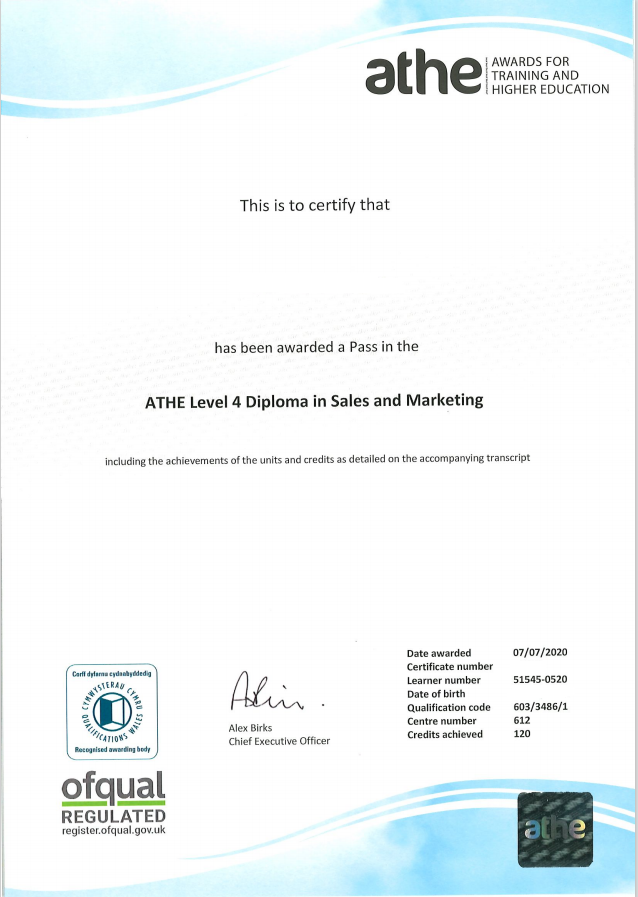
      Level 4 sample certificate

      Level 5 sample certificate

      Career path

      Successful completion of the undergraduate level 4 (Sales and Marketing) and level 5 (Extended Diploma in Management) and final year of an accredited undergraduate degree programme will give students the right credentials to go on and apply for a job in marketing, sales, human resources,management or business consultancy.

      Need any help? Request a call back from one of our advisors

      Request a Call Back

      Other courses that may also be of interest to you

      Progress onto University final Year

      Accounting and Finance, University 1st and 2nd Year (Level 4 and 5)

      View Course

      Progress onto University final Year

      Business Management, University 1st and 2nd Year (Level 4 and 5)

      View Course

      Progress onto University final Year

      Leadership and Teamwork, University 1st and 2nd Year (Level 4 and 5)

      View Course